Extended Observation Descriptions
Extended Observation Descriptions on Nuclearia simplex
Nuclearia simplex Cienkowski, 1865
Nuclearia simplex on Moss Filaments (Drepanocladus aduncus) from a Freshwater Aquarium
Fig. 1: Nuclearia simplex in the final stage of binary fission. Nuclei and pseudopods ar depicted. Curved pseudopods are typical for nucleariid amoebae.
Scale bar indicates 50 µm.
Fig. 2: Nuclearia simplex after binary fission with a thin plasma thread that still connects the two cells. The upper cell caught a cryptophyt flagellate of the species Goniomonas truncata.
Scale bar indicates 25 µm.
Nuclearia simplex in the Bog “Moor bei Kaltenhof” near Kiel (Schleswig-Holstein, Germany)
The images below show three optical sections through a cell. Note the form of the pseudopodia, the nucleus, mitochondria and the contractile vacuole. They are marked with arrows as examples:
blue (pseudopodia), orange (mitochondria), brown (contractile vacuole), green (nutrition vacuole),
black (nucleus).
© Wolfgang Bettighofer,
images under Creative Commons License V 3.0 (CC BY-NC-SA).
For permission to use of (high resolution) images please contact postmaster@protisten.de.
New items
insigne
cucurbita
fimbriata
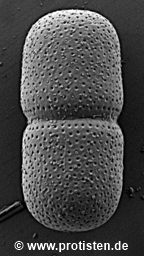
cucurbita
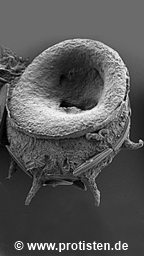
spinosa
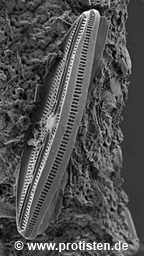
praegeri
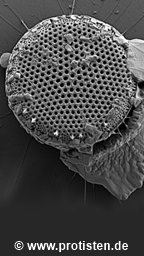
leptopus
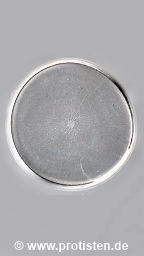
wailesii
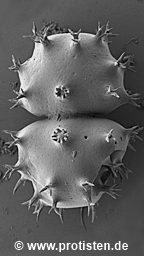
armatum
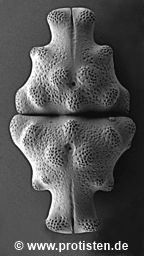
neosinuosum
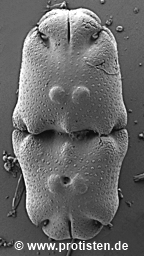
ventricosum
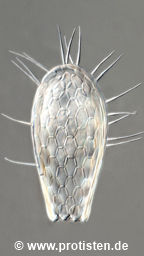
filifera
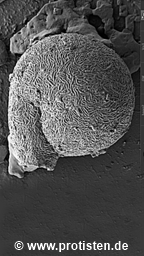
spiralis
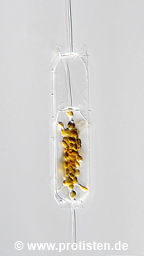
brightwellii
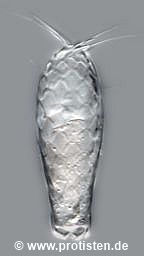
cristata
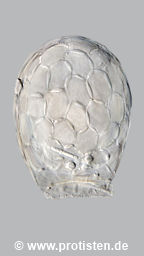
labiata
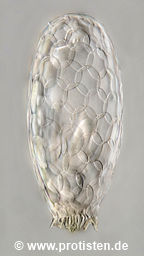
elongata
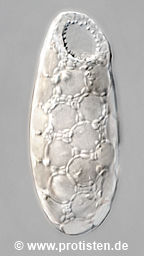
enchelys
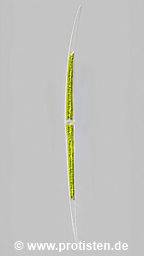
pronum
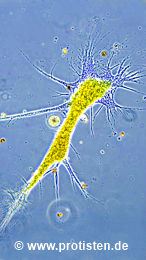
labyrinthuloides
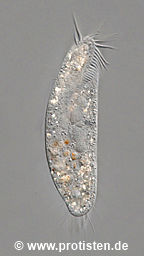
pellionellum
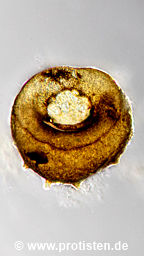
discoides
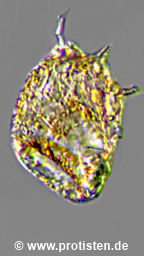
gibba
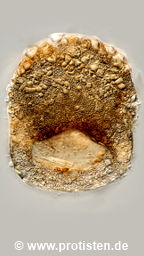
cassis
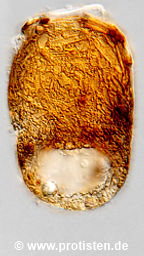
elongata
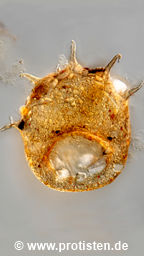
oblonga
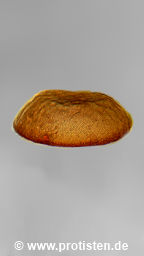
bathystoma
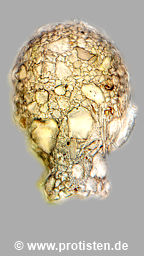
capreolata
var. masurica
globulosa
New items
insigne
cucurbita
fimbriata
cucurbita
spinosa
praegeri
leptopus
wailesii
armatum
neosinuosum
ventricosum
filifera
spiralis
brightwellii
cristata
labiata
elongata
enchelys
pronum
labyrinthuloides
pellionellum
discoides
gibba
cassis
elongata
oblonga
bathystoma
capreolata
var. masurica
globulosa


