Extended Observation Descriptions
Extended Observation Description on Nuclearia spec.
Nuclearia Cienkowski, 1865
Defecation in Nuclearia spec.
Fig. 1: Defecation in a Nuclearia cell. a Cell with large defecation vacuole. b The vacuole has migrated to the edge of the cell. c The vacuole has opened to the outside. d and e The indigestible material is being discharged. f End of the defecation process.
Scale bar indicates 25 µm. Sample from a tropical freshwater aquarium.
The images above show a Nuclearia cell which has trapped a large piece of indigestible material in a vacuole. Its shininess in polarized light indicated its birefringent property. This and the fibrous structure leads to the conclusion that it is a cellulose particle. The series of images shows how the piece of cellulose was excreted. Unlike ciliates, for example, amoeboids have no special areas prepared for defecation openings, no cytoproct. Figure 1 f gives the impression that the large piece of waste affected the cell somewhat during the excretion process. In the genus Nuclearia, however, the formation of such cell appendages is not uncommon.
© Wolfgang Bettighofer,
images under Creative Commons License V 3.0 (CC BY-NC-SA).
For permission to use of (high resolution) images please contact postmaster@protisten.de.
New items
insigne
cucurbita
fimbriata
cucurbita
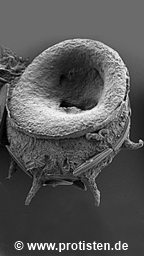
spinosa
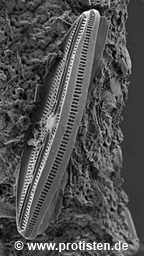
praegeri
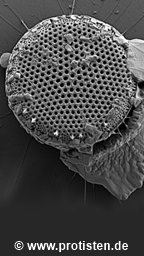
leptopus
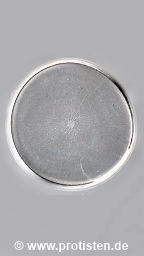
wailesii
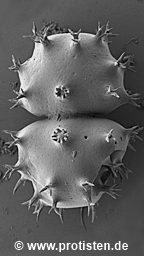
armatum
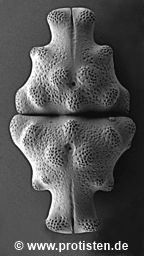
neosinuosum
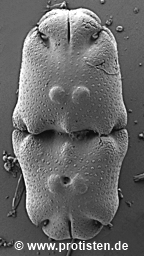
ventricosum
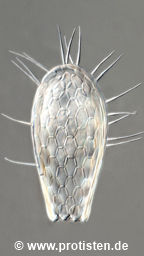
filifera
spiralis
brightwellii
cristata
labiata
elongata
enchelys
pronum
labyrinthuloides
pellionellum
discoides
gibba
cassis
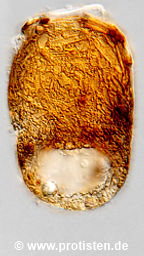
elongata
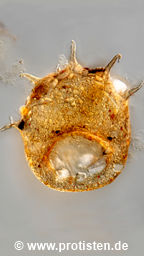
oblonga
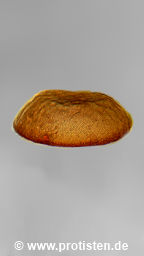
bathystoma
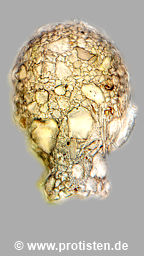
capreolata
var. masurica
globulosa
New items
insigne
cucurbita
fimbriata
cucurbita
spinosa
praegeri
leptopus
wailesii
armatum
neosinuosum
ventricosum
filifera
spiralis
brightwellii
cristata
labiata
elongata
enchelys
pronum
labyrinthuloides
pellionellum
discoides
gibba
cassis
elongata
oblonga
bathystoma
capreolata
var. masurica
globulosa


