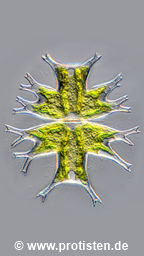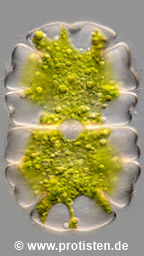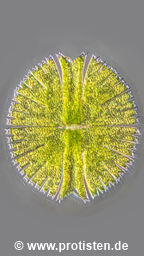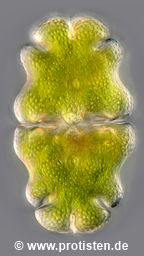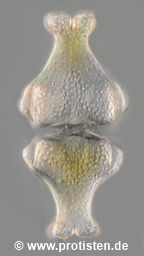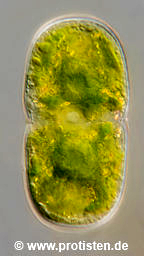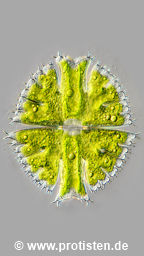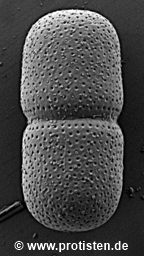
Extended Observation Descriptions
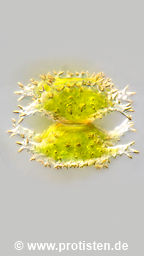
Extended Observation Description on Micrasterias fimbriata
Micrasterias fimbriata Ralfs 1848
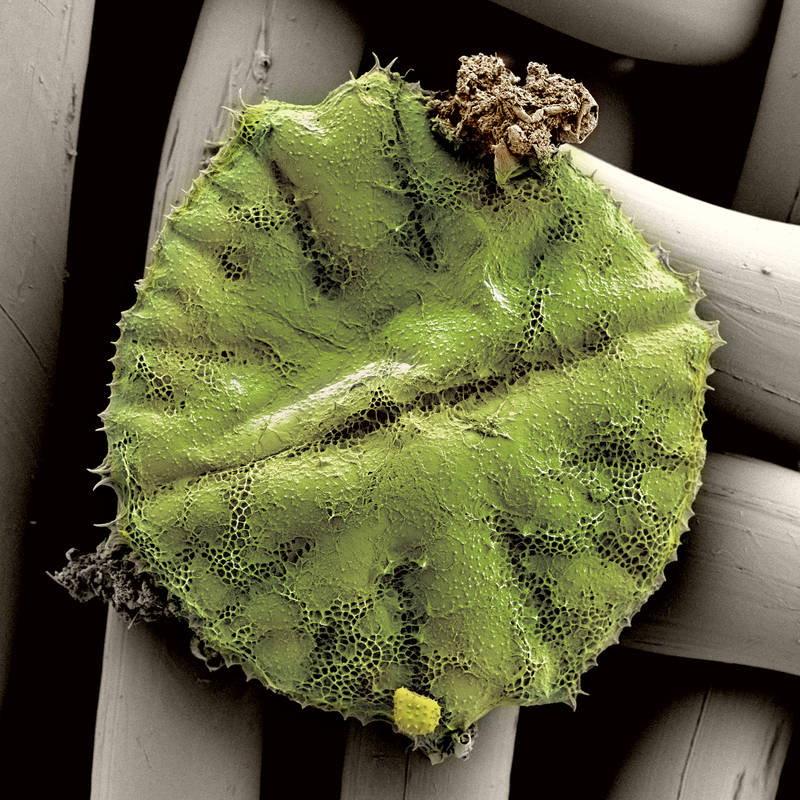
The meshwork of cellulose microfibrils in the primary cell wall of Micrasterias fimbriata
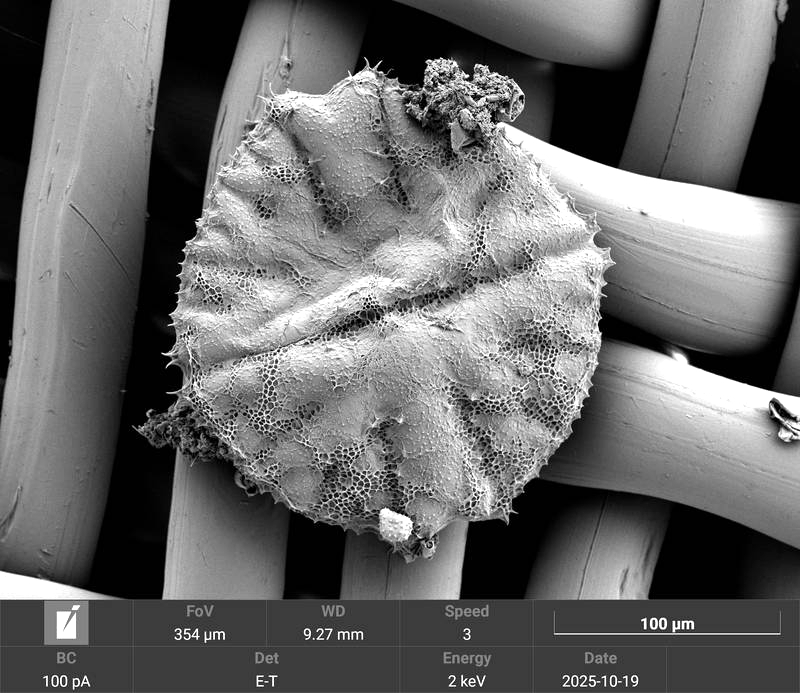
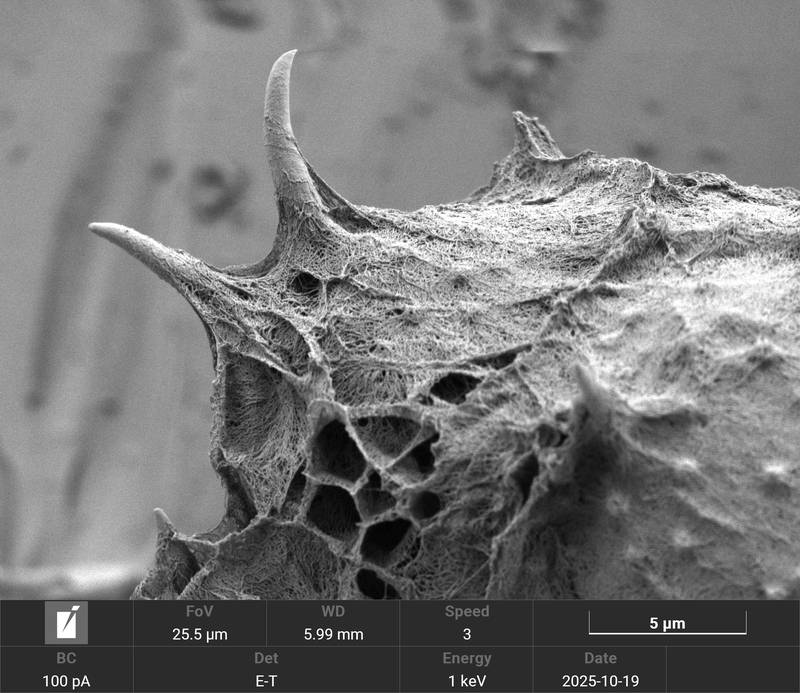
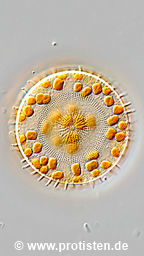
Sampling date 06/2025. Scale bars indicate 100 µm (1), 5 µm (2).
Two images. Even in the overview image, a net-like covering is visible.
Please click on < or > on the image edges or on the dots at the bottom edge of the images to browse through the slides!
Place name: Moor called Schwemm near Walchsee (Tyrol, Austria)
Latitude: 47.657707 Longitude: 12.299540 Elevation: 669 m
Tescan Clara SEM, © Wolfgang Bettighofer/Jürgen Stampfl
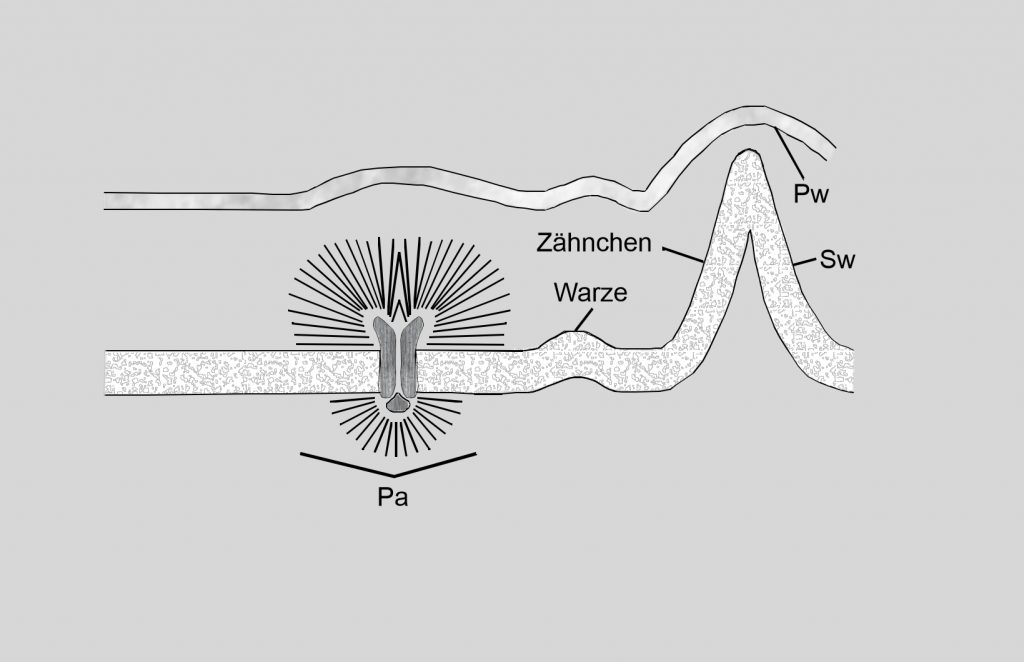
As the schematic diagram in Brook (1981) shows, in the Cosmarium-type cell wall, which is also found in the genus Micrasterias, the thin primary wall remains in use even in the mature cell and is not shed or dissolved, as is typical in other Streptophytes and Chlorophytes. It envelops the gelatinous layer of mucopolysaccharides that lies on top of the resistant secondary wall. This gelatinous layer, produced in the cell’s dictyosomes, is transported to the outside via the pore apparatuses and protects the cell.
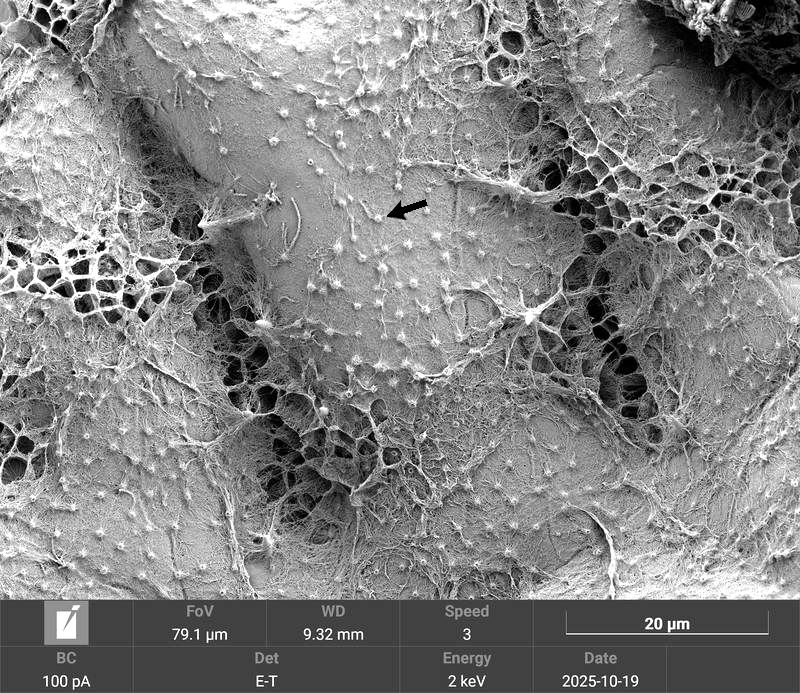
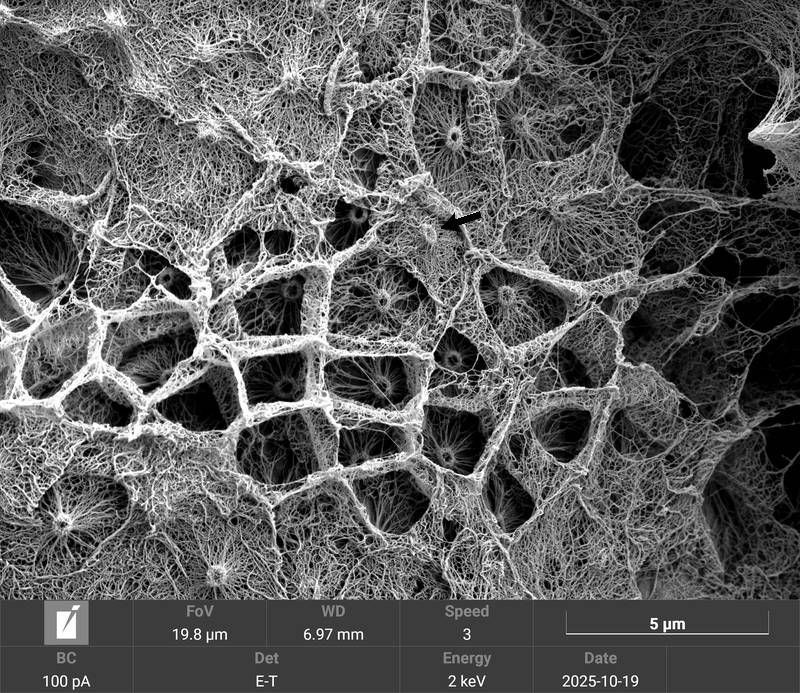
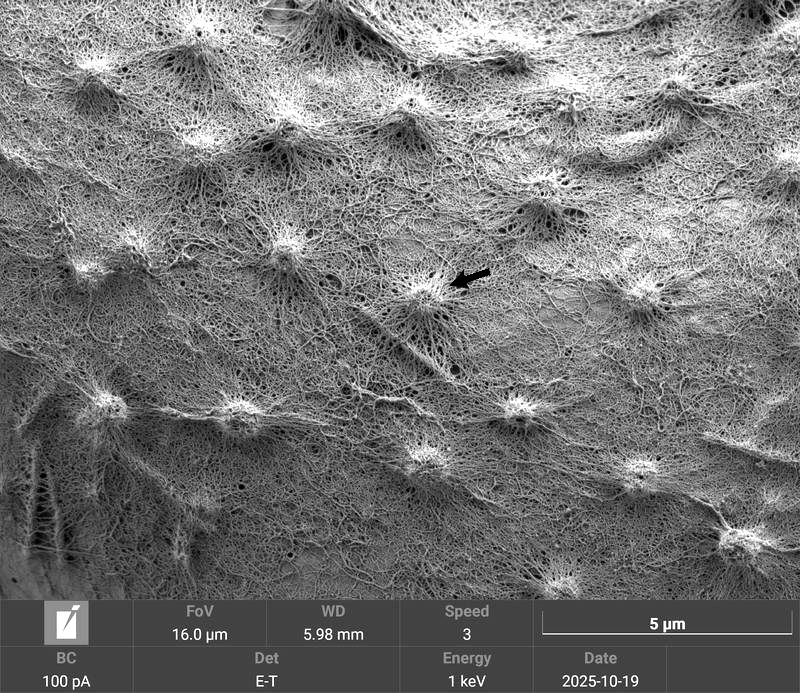
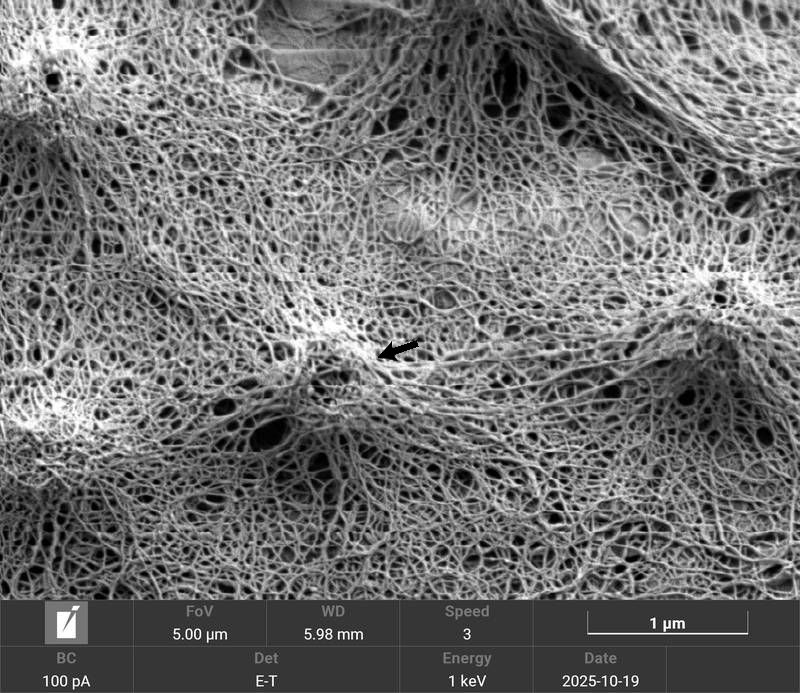
Using critical point drying for a preparation for examination in the SEM, it was possible to visualize the network of cellulose microfibrils of the primary wall in Micrasterias fimbriata as well as the swellings of the pore apparatuses.
Scale bars indicate 20 µm (1), 5 µm (2, 3), 1 µm (4).
Four images in a slide changer.
Please click on < or > on the image edges or on the dots at the bottom edge of the images to browse through the slides!
The magnification series above impressively shows the network of cellulose microfibrils in the primary wall. The protuberances, marked with arrows, represent the pore apparatuses in the underlying secondary wall.
In the last image, at the highest magnification, the diameters of the microfibrils become measurable. Within the limits of measurement accuracy, the finest visible strands have diameters of approximately 10 nm. This order of magnitude corresponds well with the findings of Giddings et al. (1980). They had observed that during the formation of the primary wall, isolated production apparatuses of cellulose microfibrils (so-called rosettes) produce microfibrils with a diameter of 5 nm. They were further able to show that during the formation of the secondary wall, hexagonally arranged arrays of rosettes produce complex fibrils with a diameter of 28 nm, which form the basis of the secondary wall.
References
Brook, A. J. (1981). The biology of desmids (Vol. 16). University of California Press.
Giddings Jr, TH, Brower, DL, & Staehelin, LA (1980). Visualization of particle complexes in the plasma membrane of Micrasterias denticulata associated with the formation of cellulose fibrils in primary and secondary cell walls. The Journal of cell biology , 84 (2), 327-339.
© Wolfgang Bettighofer,
images under Creative Commons License V 3.0 (CC BY-NC-SA).
For permission to use of (high resolution) images please contact postmaster@protisten.de.
New items
var. masurica
globulosa
truncata
parva
globularis
fimbriata
chinensis
wailesii
concinnus
filifera
lineare
urceolata
enchelys
oblonga
artocrea
crenulata
spec.
brevicolla
placentula
var. euglypta
bryophila
spiralis
galeata
mitrata
gibbosa
didelta
immanata
acuminata
granulata
mucosa
var. laevicincta
rectum
bacillifera
brevicaulis
nasutum
striolatum
teliferum
pseudopyramidatum
New items
var. masurica
globulosa
truncata
parva
globularis
fimbriata
chinensis
wailesii
concinnus
filifera
lineare
urceolata
enchelys
oblonga
artocrea
crenulata
spec.
brevicolla
placentula
var. euglypta
bryophila
spiralis
galeata
mitrata
gibbosa
didelta
immanata
acuminata
granulata
mucosa
var. laevicincta
rectum
bacillifera
brevicaulis
nasutum
striolatum
teliferum
pseudopyramidatum