Amoebozoa (Part), Stramenopiles (Part), Rhizaria (Part)
Observations on Saccamoeba limax
Protisten / Home / Naked Amoeboid Protists / Amoebozoa / Tubulinea / Elardia / Euamoebida / Hartmannellidae / Saccamoeba limax
Position in the EOL taxonomic tree. Please click on the tree view below to access EOL (Encyclopedia of Life).
Saccamoeba limax (Dujardin, 1841) Page, 1974
Most likely ID: n.a.
Basionym: Amoeba limax Dujardin, 1841
Add’l Synonyms: Hartmanella limax (Dujardin, 1841) Page, 1969
Sampling date 06/2007. Scale bar indicates 10 µm.
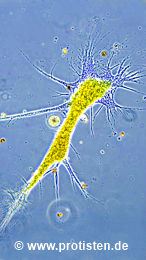
Saccamoeba limax with its villous uroid. Two pseudopods protrude only during change of direction. During ordinary movement on substrate the appearance is monopodial. The inserts show states of defecation.
Place name: Bog Dosenmoor near Neumuenster (Schleswig-Holstein, Germany)
Latitude: 54.136219 Longitude: 10.026433
Microscope Zeiss Universal, camera Olympus C7070WZ.
Sampling date 10/2008. Scale bar indicates 10 µm.
Floating form of Saccamoeba limax with a characteristic villous collar and the cuboidal crystals. The vesicular nucleus with its huge central nucleolus lies in the middle of the cell. Left of Saccamoeba we can see the prey: Pyxidicula spec., a testate amoeba.
Place name: Pond Suploch, Hiddensee (Germany)
Latitude: 54.538638 Longitude: 13.097802
Microscope Zeiss Universal, camera Olympus C7070WZ.
Scale bars indicate 10 µm (1, 6, 7), 25 µm (2–5).
7 stages of phagocytosis of Pyxidicula operculata.
Last image: Phagocytosis of Pyxidicula has completed. On the right the typical finely papillate bulbous uroid which recalls the family Amoebidae. Two empty tests of Pyxidicula had been discharged and stayed connected through fine plasma ribbons to the uroid.
Please click on < or > on the image edges or on the dots at the bottom edge of the images to browse through the slides!
Place name: Pond Suploch, Hiddensee (Germany)
Latitude: 54.538638 Longitude: 13.097802
Microscope Zeiss Universal, camera Olympus C7070WZ.
| First: | Saccamoeba limax in „classical“ shape as it can be found in literature. From the left to the right we see the cuboidal crystals (typical for this species), several food vacuoles, the vesicular nucleus with its huge central nucleolus, the contractile vacuole and another food vacuole. On the right the likewise typical finely papillate bulbous uroid which recalls the family Amoebidae. |
| Second: | Saccamoeba limax changes its direction of locomotion. During this period the classical, monopodial shape is lost. |
Scale bars indicate 25 µm.
Motion study, 3 stages.
Saccamoeba limax in „classical“ shape as it can be found in literature. There are several cuboidal crystals (typical for this species), food vacuoles and the vesicular nucleus with its huge central nucleolus. On the left the likewise typical finely papillate bulbous uroid which recalls the family Amoebidae.
Please click on < or > on the image edges or on the dots at the bottom edge of the images to browse through the slides!
Place name: Tropical freshwater aquarium
Latitude: 54.3018013 Longitude: 10.07120132
Microscope Zeiss Axioplan, camera Olympus OM-D M5 MKII. DOF images.
© Wolfgang Bettighofer,
images under Creative Commons License V 3.0 (CC BY-NC-SA).
For permission to use of (high resolution) images please contact postmaster@protisten.de.
New items
discoides
gibba
cassis
elongata
oblonga
bathystoma
capreolata
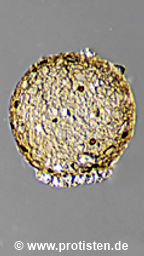
var. masurica
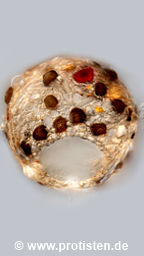
globulosa
truncata
parva
globularis
fimbriata
chinensis
wailesii
concinnus
filifera
lineare
urceolata
enchelys
oblonga
artocrea
crenulata
spec.
brevicolla
placentula
var. euglypta
bryophila
spiralis
galeata
mitrata
gibbosa
didelta
immanata
acuminata
granulata
mucosa
var. laevicincta
rectum
bacillifera
brevicaulis
nasutum
striolatum
teliferum
pseudopyramidatum
New items
discoides
gibba
cassis
elongata
oblonga
bathystoma
capreolata
var. masurica
globulosa
truncata
parva
globularis
fimbriata
chinensis
wailesii
concinnus
filifera
lineare
urceolata
enchelys
oblonga
artocrea
crenulata
spec.
brevicolla
placentula
var. euglypta
bryophila
spiralis
galeata
mitrata
gibbosa
didelta
immanata
acuminata
granulata
mucosa
var. laevicincta
rectum
bacillifera
brevicaulis
nasutum
striolatum
teliferum
pseudopyramidatum