Tiny Organisms in Aquatic Habitats
Protisten.de    Tiny Organisms in Aquatic Habitats
Menu
Menu

Testate Amoebae –
Amoebozoa (Part), Stramenopiles (Part), Rhizaria (Part)

Observations on Lesquereusia spiralis

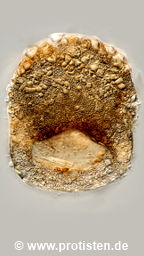
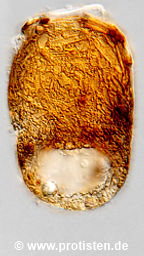
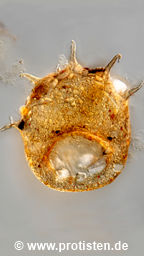
Lesquereusia spiralis

Taxonomic tree according to Lahr et al., 2019 (https://doi.org/10.1016/j.cub.2019.01.078)
and González-Miguéns et al., 2022 (https://doi.org/10.1016/j.ympev.2022.107557)

Amorphea Adl et al., 2012
Amoebozoa Lühe, 1913, renewed definition Cavalier-Smith, 1998
● Tubulinea Smirnov et al., 2005
●● Elardia, Kang et al., 2017
●●● Order Arcellinida Kent, 1880
●●●● Suborder Glutinoconcha Lahr et al., 2019
●●●●● Infraorder Longithecina Lahr et al., 2019
●●●●●● Family Lesquereusiidae Jung, 1942
●●●●●●● Genus Lesquereusia Schlumberger, 1845

Lesquereusia spiralis (Ehrenberg, 1840) Tanárek, 1881

Most likely ID: n.a.

Basionym: Difflugia spiralis Ehrenberg, 1840

Add’l Synonyms: Lesquereusia jurassica Schlumberger, 1845

Sampling date 10/2008. Scale bars indicate 50 µm (1), 10 µm (2), 25 µm (3), 10 µm (4), 5 µm (5) .

Five images.

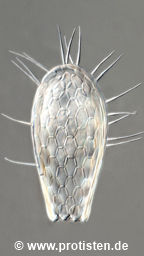
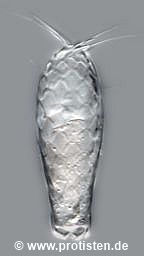
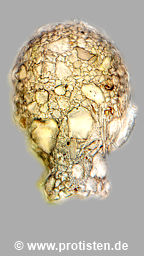
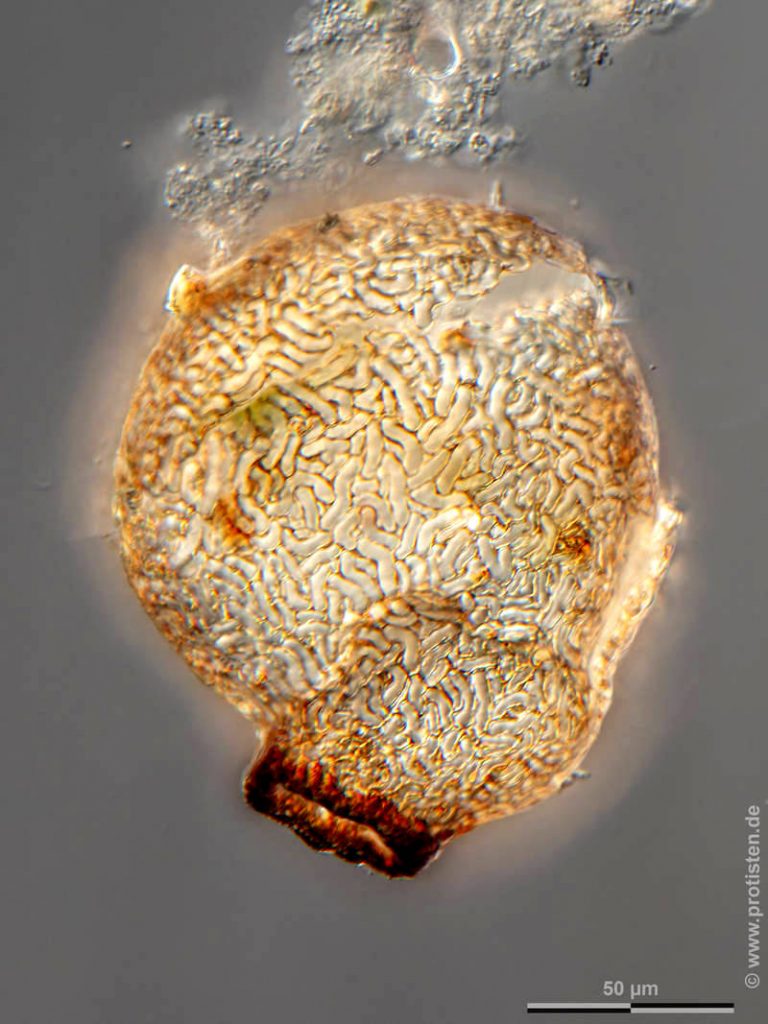
First:Synoptic representation of the test (shell). It primarily consists of idiosomes (self made siliceous particles looking like sausages). A few xenosomes (incorporated grains of sand) are visible. All xenosomes are covered with a siliceous coating.
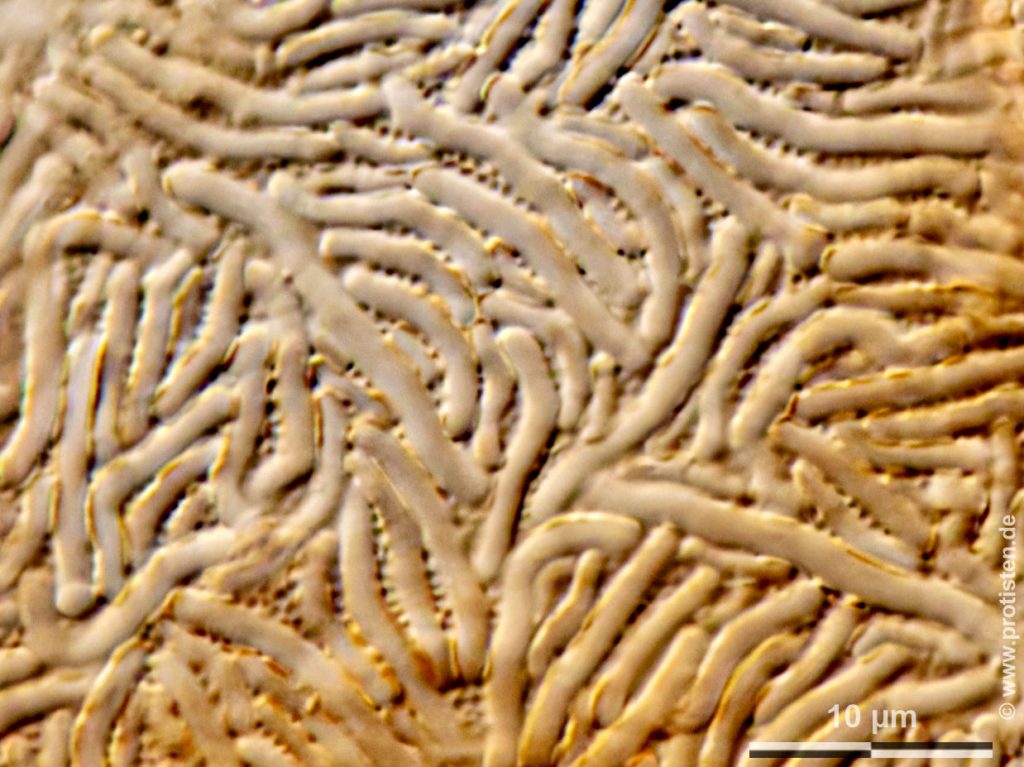
Second and third:A closer look on the idiosomes. We see many sieve-like regions which are identical to the proteinaceous matrix of the test, in which idiosomes and xenosomes (e.g. quartz grains) are embedded.
Fouth:Region of the test´s neck with a large quartz grain, which is covered with silica produced by the amoeba.
Fifth:A look inside the test shows that idiosomes are produced in reserve and stored in the cytoplasm in order to be used during cell division to build the test of the daughter cell.

Please click on < or > on the image edges or on the dots at the bottom edge of the images to browse through the slides!

Place name: Pond Suploch, Hiddensee (Germany)
Latitude: 54.538638     Longitude: 13.097802   Elevation: -1 m

Microscope Zeiss Universal, camera Olympus C7070WZ. DOF images.

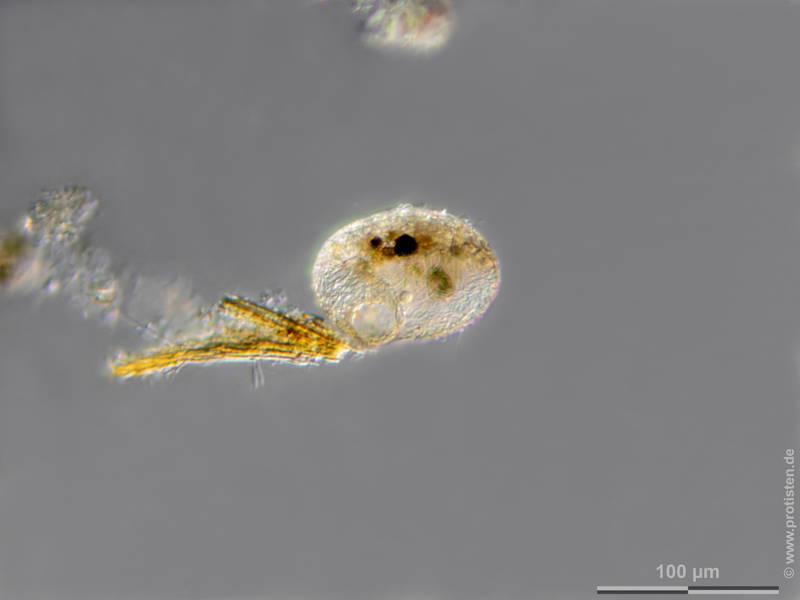
Sampling date 10/2019. Scale bars indicate 100 µm.

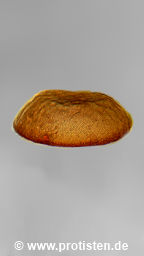
Two images, taken with a dissecting microscope.

Please click on < or > on the image edges or on the dots at the bottom edge of the images to browse through the slides!

Place name: Bog Waasenmoos, Pass Thurn near Mittersill (Tyrol, Austria)
Latitude: 47.30234117     Longitude: 12.41751194   Elevation: 1278 m

Stereo microscope Olympus SZX16, camera Olympus OM-D M5 MKII. DOF images.

Lesquereusia spiralis

Sampling date 09/2009. Scale bars indicate 50 µm.

Place name: Wetland near Schladming (Austria)
Latitude: 47.380787     Longitude: 13.826380   Elevation: 1142 m

Microscope Zeiss Universal, camera Olympus C7070WZ. DOF images.

Lesquereusia spiralis

Sampling date 6/2025. Scale bar indicates 100 µm.

Place name: Moor called Schwemm near Walchsee (Tyrol, Austria)
Latitude: 47.657707   Longitude: 12.299540   Elevation: 669 m

Stereo microscope Olympus SZX16, camera Olympus OM-D M5 MKII. DOF images.

Lesquereusia spiralis

Sampling date 06/2025. Scale bars indicate 50 µm.

Place name: Moor called Schwemm near Walchsee (Tyrol, Austria)
Latitude: 47.657707   Longitude: 12.299540   Elevation: 669 m

Microscope Zeiss Axioplan, camera Olympus OM-D M5 MKII. DOF image.

Lesquereusia spiralis

Sampling date 06/2025. Scale bars indicate 25 µm (1–4), 10 µm (5).

Five images, four of them in a slide changer.

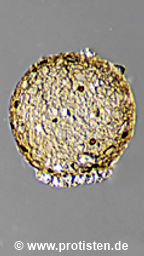
First:Synoptic view of the test (shell). It consists mainly of idiosomes (self-formed, sausage-shaped silica particles). Occasionally, xenosomes (probably spherical chrysophyte cysts) are visible. All xenosomes are coated with a layer of silica.
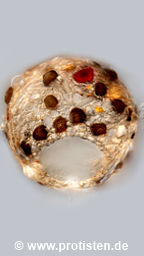
Second to fourth:A look inside the shell shows that idiosomes are produced as a reserve and stored in the cytoplasm to be used during cell division to build the test of the daughter cell.
Fifth:A closer look on the idiosomes. We see many sieve-like regions which are identical to the proteinaceous matrix of the test, in which idiosomes and xenosomes are embedded.

Please click on < or > on the image edges or on the dots at the bottom edge of the images to browse through the slides!

Place name: Moor called Schwemm near Walchsee (Tyrol, Austria)
Latitude: 47.657707   Longitude: 12.299540   Elevation: 669 m

Microscope Zeiss Axioplan, camera Olympus OM-D M5 MKII. DOF images.

Lesquereusia spiralis

Sampling date 06/2025. Scale bars indicate 50 µm (1) 20 µm (2, 3).

Images of three specimen, two of them in a slide changer.

Please click on < or > on the image edges or on the dots at the bottom edge of the images to browse through the slides!

Place name: Moor called Schwemm near Walchsee (Tyrol, Austria)
Latitude: 47.657707   Longitude: 12.299540   Elevation: 669 m

Tescan Clara SEM, © Wolfgang Bettighofer/Jürgen Stampfl

Sampling date 06/2025. Scale bars indicate 10 µm (1), 5 µm (2), 2 µm (3), 0,5 mm (4) .

Four images. 
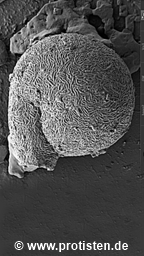
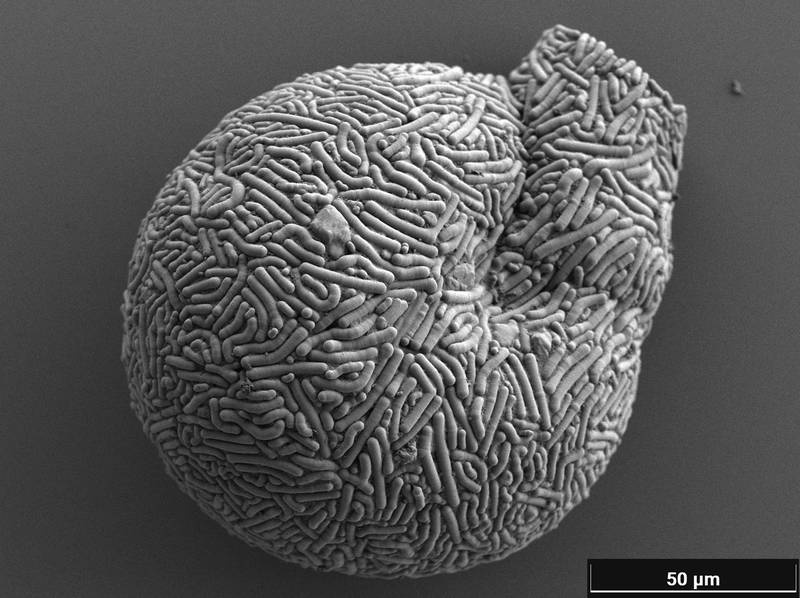
Details of the shell surface in increasing magnification, showing the shape and arrangement of the curved silica rods and the intervening network of organic cement.

Place name: Moor called Schwemm near Walchsee (Tyrol, Austria)
Latitude: 47.657707   Longitude: 12.299540   Elevation: 669 m

Tescan Clara SEM, © Wolfgang Bettighofer/Jürgen Stampfl

© Wolfgang Bettighofer,
images under Creative Commons License V 3.0 (CC BY-NC-SA).
For permission to use of (high resolution) images please contact postmaster@protisten.de.

New items

New items